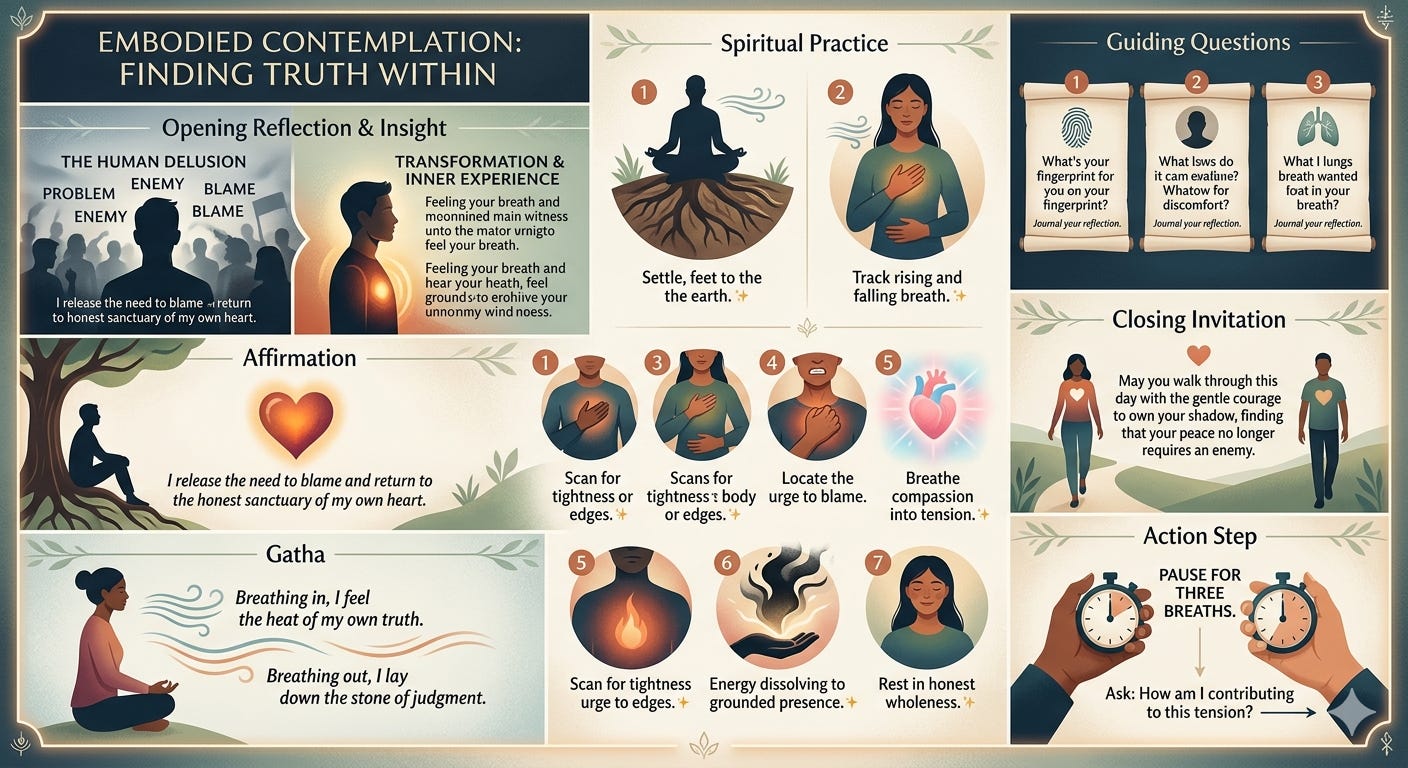
We often carry an invisible weight, a ancient reflex that seeks to export our internal discomfort onto others. This “scapegoat mechanism” is a clever delusion of the ego, designed to protect us from the stinging heat of our own shadows. By naming an external enemy or playing the victim, we temporarily soothe our anxiety and settle the dust of our own unexamined guilt. Yet, this relief is a phantom; it tether us to a cycle of sacralized violence where we justify our hardness of heart by calling it protection, truth, or even love.
True transformation begins the moment we stop looking across the fence and start feeling the ground beneath our own feet. It requires the courage to keep our own feet to the fire, choosing to witness our impulse to blame without acting upon it. When we consciously name this pattern, the heavy armor of judgment begins to melt, revealing a spacious, embodied awareness. In this clarity, we no longer need to diminish others to feel whole; we find a steady, interior sovereignty that refuses to create new victims.
Affirmation I release the need to blame and return to the honest sanctuary of my own heart.
Breathing in, I feel the heat of my own truth.
Breathing out, I lay down the stone of judgment.
Spiritual Practice Settle into your seat and feel the weight of your body pressing into the earth. ✨
Place one hand on your heart and the other on your belly to track the rising and falling of your breath. ✨
Scan your body for any tightness or “sharp edges” that arise when you think of a current conflict or grievance. ✨
Locate the specific sensation of the urge to blame—perhaps a clenching in the jaw or a heat in the chest—and simply witness it without moving. ✨
Breathe directly into that tension, offering yourself the compassion you usually export as judgment. ✨
Imagine the energy of blame dissolving into a soft, grounded presence that keeps you anchored in your own skin. ✨
Rest in the quiet realization that you are safe enough to be wrong and whole enough to be honest. ✨
Guiding Questions
Where in my body do I feel the impulse to “point the finger” or defend my innocence?
What underlying discomfort or shame am I trying to avoid by making someone else the problem?
How would my breath change if I no longer needed to maintain the “moral high ground” over others?
Closing Invitation May you walk through this day with the gentle courage to own your shadow, finding that your peace no longer requires an enemy.
Action Step The next time you feel the urge to complain about or criticize someone, pause for three breaths and identify one way you might be contributing to the very tension you feel.
Would you like me to create an image representing this transition from external blame to internal grounding to assist with your contemplation?