Learning to Love the Stranger
In a time when global migration, political division, and cultural fear shape daily conversation, the question of how we welcome the stranger presses urgently upon the human heart.
There is something deeply honorable in our humanity: we are capable of love that reaches beyond familiarity. The longing to care for others is already planted within us. Yet the measure of that love is not found in the language we use about the sacred, but in the way we encounter the person who stands outside our circle of comfort.
A hard question rises quietly in the soul. If devotion to God does not reshape the way we respond to the suffering around us, what purpose does religion truly serve? Words about God can easily become a screen that reflects only ourselves. We begin to imagine that faith exists to protect our identity, our nation, our tribe, or our sense of security. In those moments the heart contracts, and the light we hoped to see becomes dim.
None of us intends to live this contradiction. Yet history shows how often communities of faith echo the fears and assumptions of the surrounding culture. People who speak of one God sometimes forget the obvious implication: every human being carries equal dignity as a child of that one Source. Borders, class systems, and cultural divisions may organize societies, but they cannot define the worth of a person.
“Have I even begun to love?” —Richard Rohr
That question exposes both our struggle and our possibility. It recognizes that the work of love is unfinished in every life. Fear of the unfamiliar, anxiety about resources, and inherited prejudice can quietly shape our responses. We may look at a migrant, a refugee, or a foreigner and feel uncertainty rather than kinship.
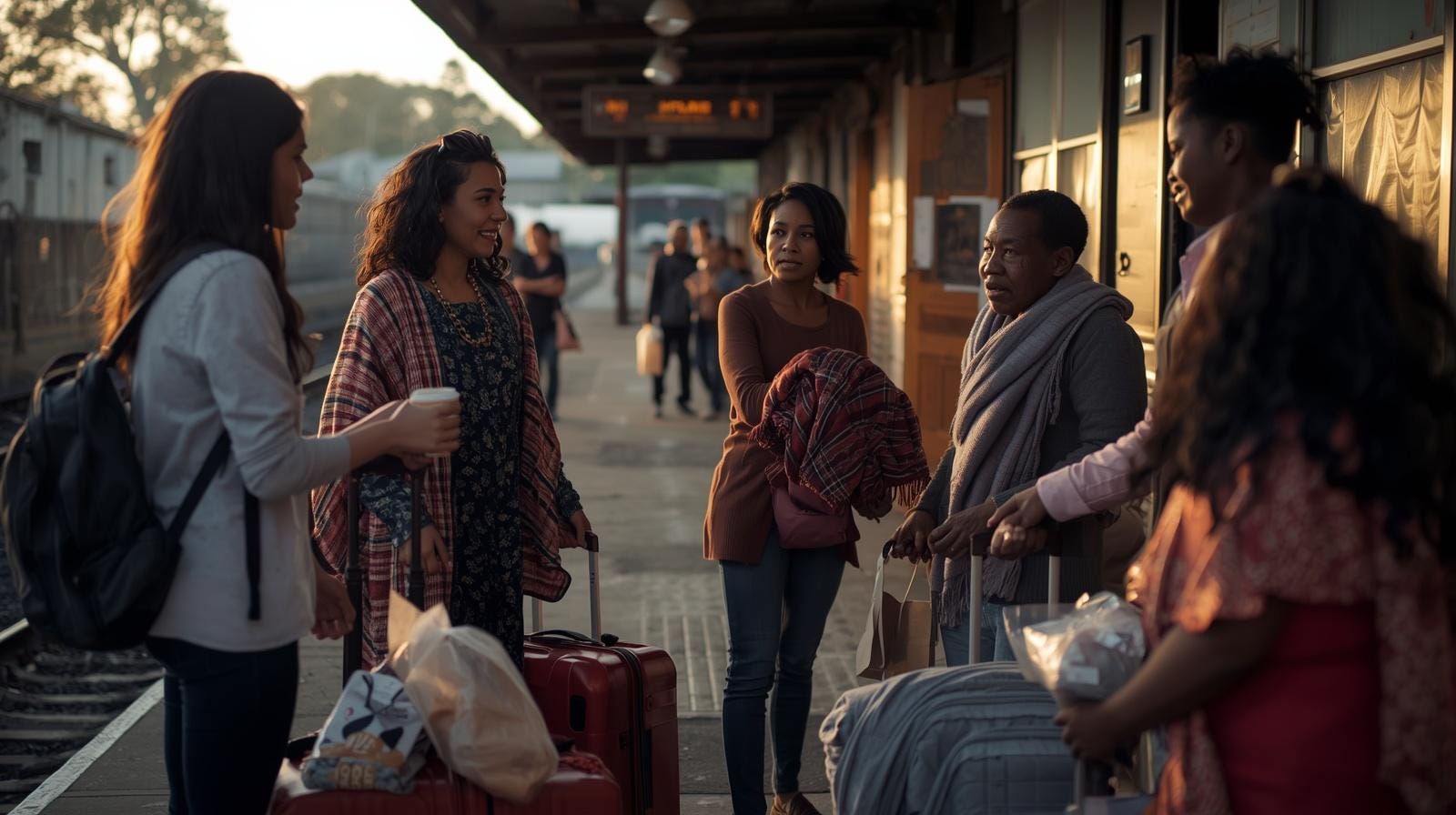
Yet another possibility opens when we remember the call to welcome the stranger. People fleeing war, hunger, violence, and unbearable conditions are not abstractions. They are brothers and sisters whose dignity has been shaken but not erased. Solidarity begins when we see their story as part of our own shared human story.
Love grows whenever we cross the boundaries that once kept us apart. It grows when we listen before judging, when we offer hospitality instead of suspicion, when we allow compassion to guide our public life as well as our private prayers.
And perhaps the truest sign of faith is this simple courage: to keep beginning again in love.
Let us gently release our thoughts and settle into a quiet openness before the mystery that calls us to love. Rest in the silence for a few minutes.
Be Still and Know
Breathing in... I arrive in this moment.
Breathing out... I welcome the stranger within and around me.
Heart of the Message: Genuine love of God becomes real only when it transforms how we treat the stranger and the vulnerable.
Where in your life might love be inviting you to cross a boundary you once assumed was fixed?
Night settles over distant roads
where footsteps carry stories of loss and courage.
A lantern glows in a quiet window,
its light small but steady.
Somewhere a door opens.
Warm bread is placed on a table.
Names are spoken slowly,
learning the shape of unfamiliar syllables.
Wind moves through the trees
as if the earth itself were breathing.
And in that breathing
the world remembers—
no one was meant
to walk alone.
If these words stirred something in you, you are welcome to share the reflection or quietly offer your own response.
The Quiet Refusal
A leaf detaches from the branch before it knows the wind. In the moment of falling, it believes the world must be built upon independence, that to rest upon air is failure of strength. Yet what appears as freedom may in truth be drift, and what is called strength may only conceal fear. There is in every human heart a small refusal—the wish to be the sou…
Breaking the Cycle

Human life carries wounds, yet beneath the bruised surface of history and memory there remains a deep interior ground that has never been conquered. Harm arrives through systems, through relationships, through the inherited habits of punishment that echo from childhood into institutions. Many have been trained to believe that justice means removal, excl…